Shaft Cable
Clamps
The SK range of shaft cable clamps in SG 42 cast iron. Self-tightening wedge design with Sherardised ArmorGalv® corrosion protection. Built for high loads and demanding shaft environments.
Ten sizes covering cables from 6 mm to 115 mm. Two-component design for fast installation. Colour-coded by load range. CSIR tested for tensile strength and rockfall.
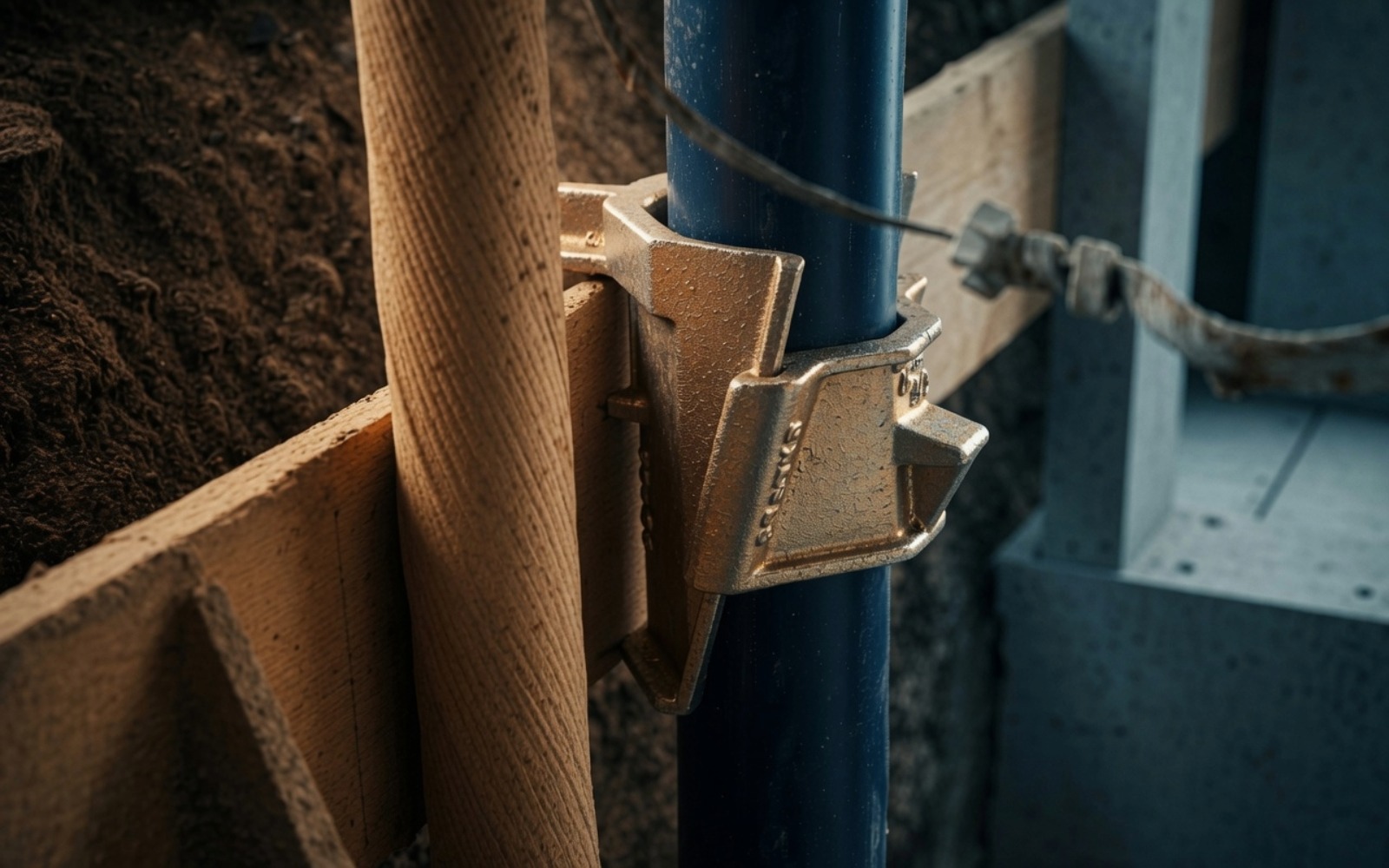
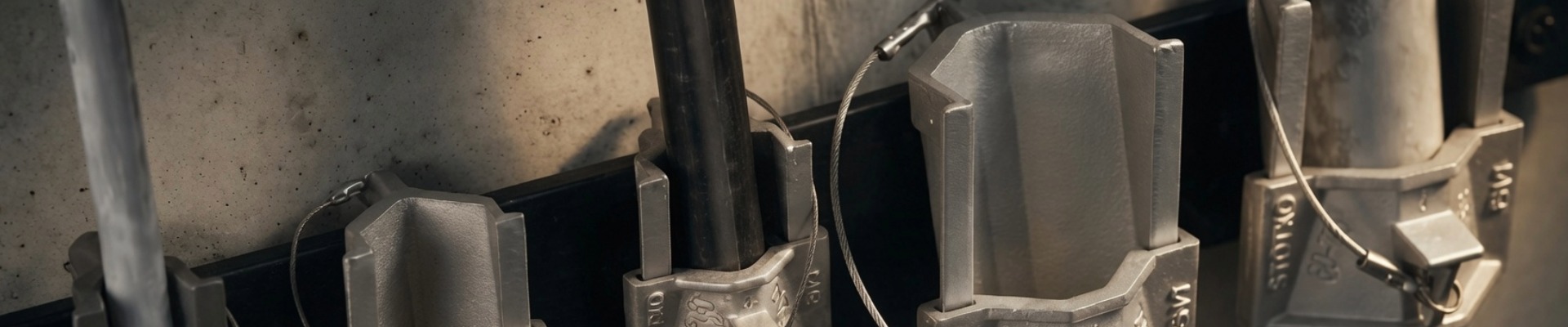
The Complete SK Range - 10 Sizes · 6 mm to 115 mm
SG 42 Cast Iron · Sherardised ArmorGalv® · CSIR Tested
Eight Engineered Advantages
Self-Tightening Under Load
The wedge mechanism tightens automatically as the cable stretches, maintaining grip without manual intervention.
SG 42 Cast Iron Body
Spheroidal graphite cast iron provides the robust construction needed for high-load shaft cable applications.
Sherardised ArmorGalv® Finish
Multi-layer zinc-iron alloy coating gives superior corrosion resistance compared to conventional galvanising.
Two-Component Design
Just a body and a wedge. Fewer parts means faster installation, especially critical when fitting multiple cables in a shaft.
Easy Bunton Bracket Installation
The hook design simply hangs over the bunton bracket flange, no special tools or drilling required.
Quick Release for Re-use
The quick-release bolt mechanism allows clamps to be removed and re-used on new cable installations, reducing replacement cost.
Compact, Space-Saving Design
The minimal footprint of the clamp body conserves valuable shaft space, important in congested multi-cable installations.
Colour-Coding for Cable ID
The Sherardised surface accepts paint, enabling colour-coded cable identification at a glance in multi-cable shaft environments.
The Engineering
How the Self-Tightening Mechanism Works
The defining feature of the SK clamp is its passive, load-responsive grip. Understanding the wedge mechanism explains why it outperforms conventional bolted clamps over the service life of a cable.
A conventional bolted cable clamp applies a fixed clamping force at the moment of installation. As the cable stretches under cyclic loading and creep, its effective diameter decreases slightly. The fixed bolt tension remains constant, but the grip on the reduced-diameter cable is now looser than at installation. Over time, slip and cable movement become possible.
The SK clamp works differently. The body contains a tapered internal channel. The second component, the wedge, sits inside this tapered channel against the cable. When the cable diameter reduces due to stretching, the wedge is driven further into the taper by the cable load itself. The grip increases in direct proportion to the load and the cable's condition.
This is a passive, continuous process. There is no sensor, no spring and no maintenance intervention required. The physics of the wedge geometry ensures that any condition which might otherwise cause slip instead causes the clamp to tighten. The bolt serves only as a travel limiter for the wedge, not as the primary gripping force.
Cable Installed, Clamp Hung on Bunton
The clamp body hooks over the bunton bracket flange. The wedge is inserted and the bolt tightened finger-tight. The cable passes through the jaw and the wedge seats against it under initial cable weight.
Cable Load Drives the Wedge Inward
The downward force of the cable's weight acts through the wedge against the tapered channel walls. The geometry converts vertical load into horizontal gripping force on the cable. The heavier the load, the tighter the grip.
Cable Stretches Over Time - Clamp Self-Adjusts
As the cable elongates and thins under cyclic load, the wedge advances further into the taper. The grip tightens automatically. No retorquing, no maintenance inspection cycle required for grip maintenance.
Quick Release for Cable Change or Re-use
To release, the bolt is loosened and the wedge backed off. The clamp separates into its two components, both of which can be re-used on the next cable installation, reducing lifetime cost of shaft cable management.
Conventional Fixed-Bolt Clamp
Grip force is fixed at installation. As the cable stretches and diameter reduces, the clamping force relative to cable diameter decreases. Periodic manual retorquing is required to maintain safe grip. Risk of undetected slip between inspections.
SK Self-Tightening Wedge Clamp
Grip force increases automatically as cable diameter reduces under load. The clamp responds passively to cable condition at all times. No retorquing schedule required for grip maintenance. Consistent, safe cable suspension over the full service life.
Corrosion Protection
Sherardising & ArmorGalv® Coating
The SK clamp body is treated by Sherardising, a dry diffusion galvanising process that creates a bonded, multi-layer zinc-iron alloy coating. The result is the ArmorGalv® structure - superior to hot-dip galvanising and produced without acid.
Why Sherardising, Not Hot-Dip Galvanising?
Hot-dip galvanising applies a zinc coating by immersing the component in molten zinc, but the process first requires acid pickling to remove mill scale and rust. This introduces a hazardous chemical step in the process and produces acid waste requiring careful disposal.
Sherardising works entirely differently. The cast iron bodies are tumbled with zinc powder at elevated temperature in a sealed rotating drum. The zinc diffuses directly into the iron surface, creating true metallurgical bonding at each layer boundary rather than a mechanical adhesion. No acid is used at any stage. The process is both more environmentally responsible and produces a harder, more corrosion-resistant result.
The ArmorGalv® structure builds in layers, each harder and more zinc-rich than the previous. Because the coating is diffusion-bonded rather than surface-applied, it cannot peel or flake. It also remains weldable and paintable, which is what allows the colour-coding that makes multi-cable shaft identification practical.
ArmorGalv® Coating Layer Structure
ArmorGalv® forms like an onion, with each successive layer harder and more corrosion-resistant than the previous one. The outermost Zeta phase, at approximately 90% zinc, provides the primary sacrificial corrosion protection. The Gamma phase, being the hardest layer bonded directly to the base iron, provides resistance to mechanical damage. Unlike a surface-applied coating, no layer can delaminate from the one beneath it - the zinc is literally part of the casting surface.
Environmentally Responsible
No acid pickling. No acid waste disposal. The Sherardising process uses zinc powder in a sealed rotating drum at elevated temperature - no hazardous liquid chemistry at any stage of the coating process.
Colour-Coded Cable Identification
The Sherardised surface accepts standard paint. Clamps can be colour-coded by cable designation, voltage, circuit or any other system used in the shaft. Blue, yellow, red, green - applied over the finished ArmorGalv® surface.
Weldable After Sherardising
Unlike conventional galvanised surfaces that produce toxic zinc oxide fumes during welding and require full removal before any weld, the Sherardised ArmorGalv® coating remains weldable directly, simplifying site modifications or bracket attachment.
Technical Reference
SK Clamp Size Range
Ten sizes covering cables from 6 mm to 115 mm diameter. Each size overlaps with its neighbours, simplifying selection and reducing the number of stock codes needed.
Swipe sideways to view all ten sizes
| Dim. | SK 11 * | SK 21 # | SK 31 * | SK 41 | SK 60 | SK 75 *# | SK 85 | SK90/12 *# | SK100R | SK 115 |
|---|---|---|---|---|---|---|---|---|---|---|
| A | 6–11 | 12–23 | 17–31 | 23–40 | 45–57 | 55–73 | 65–81 | 70–88 | 83–95 | 93–115 |
| B | 100 | 100 | 120 | 150 | 150 | 167 | 167 | 175 | 185 | 218 |
| C | 55 | 55 | 64 | 64 | 80 | 98 | 115 | 135 | 135 | 156 |
| D | 40–45 | 40–52 | 48–75 | 56–80 | 78–99 | 102–125 | 140 | 120–145 | 130–157 | 141–165 |
| E | 36 | 36 | 36 | 36 | 43 | 43 | 48 | 47 | 47 | 50 |
| F | M8 | M8 | M8 | M8 | M10 | M12 | M12 | M12 | M12 | M12 |
CSIR Testing Footnotes
* CSIR tested for Tensile Strength - applies to SK11, SK31, SK75, SK90/12.
# CSIR tested for Rockfall - applies to SK21, SK75, SK90/12.
All testing conducted by the Council for Scientific and Industrial Research. Dimension A depicts nominal clamping range.
Simplified Storekeeping
Each SK size has a deliberately wide clamping range (dimension A), with intentional overlap between adjacent sizes. In practice, most shaft installations spanning the full 6 mm to 115 mm cable diameter range can be covered with just four or five stocked sizes rather than all ten, simplifying procurement and inventory management.
Applications
Where SK Clamps Are Used
Wherever cables need to be safely suspended and managed in vertical or inclined shafts, the SK range provides the right size and the right protection.
Mine Shaft Cable Management
Power cables, signal cables and communication cables suspended on buntons or shaft steelwork in vertical and inclined mine shafts. The primary application for the SK range, including rockfall protection cable anchoring.
High-Voltage Power Cables
Suspension of high-voltage power cables supplying underground equipment including pumps, conveyors, drilling rigs and winders. The self-tightening design maintains safe suspension as heavy cables creep over time.
Signal & Communication Cables
Smaller-diameter signal, instrumentation and communication cables running down shaft walls or bunton systems. The SK11 to SK41 range covers the smaller diameters commonly used for these lighter cables.
Construction Shaft Installations
Temporary and permanent cable management during shaft sinking and construction phases. The quick-release mechanism allows clamps to be removed and re-used as the shaft deepens and cable runs are extended.
Wet and Corrosive Shaft Environments
In shafts subject to water ingress, condensation, acid mine drainage or chemical spray, the ArmorGalv® Sherardised finish provides the corrosion resistance needed to maintain structural integrity over a long service life without regular maintenance.
Industrial Vertical Cable Runs
Cable management in tall industrial structures, silos, stacks, headgear frames and process towers where vertical cable runs require secure, low-maintenance suspension points. The SK range's compact body conserves structural clearance.
Not Sure Which SK Size You Need?
Tell us the outside diameter of the cable you need to clamp. We will identify the correct SK size and advise on quantity pricing. If you have an existing clamp to match, a description or sample is sufficient.
Why Stotko?
Why Source the SK Range From Us
CSIR Independent Testing
SK11, SK31, SK75 and SK90/12 have been independently tested by the CSIR for tensile strength. SK21, SK75 and SK90/12 tested for rockfall. The performance data is not manufacturer's claims - it's independently measured.
Engineered for Shaft Conditions
The SG 42 cast iron specification and the ArmorGalv® Sherardising process are specifically chosen for the mechanical loads and corrosive conditions found in production mine shafts. This is not a general-purpose clamp adapted for mining - it was designed for it.
Full Range In Stock
All ten SK sizes are stocked in Johannesburg. When you need clamps for a shaft installation or a replacement order, there is no lead time on stock items. Contact us for pricing and current availability confirmation.
50+ Years Engineering Experience
STOTKO Engineering has supplied mine shaft equipment and engineered products to the South African mining industry since 1973. We understand the application, the operating conditions and the procurement requirements of the mining sector.
FAQ
Common Questions
Order the SK Range
Ready to Order or Need a Quote?
All ten SK sizes are stocked in Johannesburg. Tell us the cable diameter and quantity and we will confirm the correct size with pricing and availability the same day.
What to Include in Your Enquiry
Even a cable diameter and a quantity is enough to get started. More detail helps us confirm the right size and advise on any special requirements.
Same-day quote response · All 10 SK sizes in stock · Johannesburg (SAST)
Online Enquiry
Send Us Your Clamp Requirements
Prefer to fill in a form instead of calling or emailing? Complete the details below and our team will respond with pricing and availability.
Need a replacement part instead of a full unit? Browse Spare Parts →
Thank You!
Your enquiry has been received. A member of our team will be in touch shortly with pricing and availability.